Finishing Things
The poster cost me 30 cents. The lessons cost me seven years. I still overpaid for the poster.

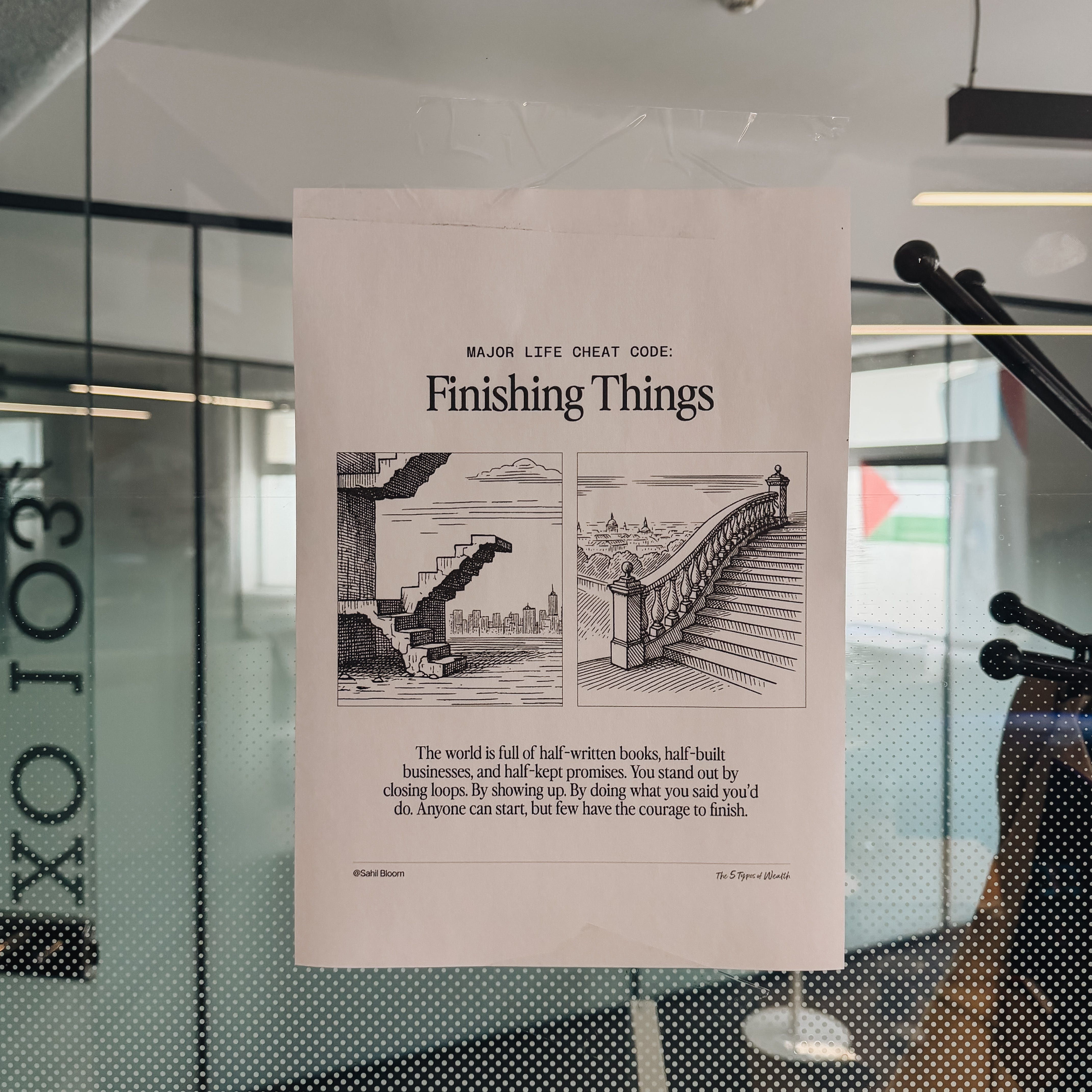
The first thing I hung in my office was a poster about finishing things.
I have not finished most things.
This is very funny if you think about it.
The poster has two staircases on it, very elegant, leading somewhere important. “MAJOR LIFE CHEAT CODE: Finishing Things.” Underneath it says something about half-written books and half-built businesses and standing out by closing loops. I nodded like a guy who closes loops. I smoothed out the creases. I felt productive just looking at it.
That was three years ago. The poster watches me open new GitHub repositories weekly. We don’t talk about it.
Let me introduce you to the graveyard. Don’t be sad, it’s a nice graveyard. The projects had good lives, some of them for almost two weeks.
LinkedLens: an AI LinkedIn profile generator. Built the MVP in a weekend, messaged everyone a few people, got a few users. The folder is still there. It’s called “linkedlens-FINAL-v3.” I have not opened it since. FINAL was a lie. But it taught me how to build with AI, so maybe it did its job.
Fleta: digital business cards. Beautiful landing page. Stripe integration worked perfectly. I showed it to maybe ten people. Somewhere there’s a domain renewal email I keep marking as unread.
DynamoBees: a hiring platform for NGOs. This one I really believed in. Deen Developers applications. Pitch decks. Calls with important people. Then something else needed attention and DynamoBees became a bookmark I scroll past while pretending I don’t see it.
A code interview tool: deployed a really good AI model for it. Like, actually good. The technical part worked beautifully. I showed it to a few people, got some “this is cool,” and then just... stopped. The model is still sitting there, deployed, probably wondering what it did wrong.
I could keep going but you get it. Forty-three projects in seven years. I counted because I thought it would be like fifteen. It was not fifteen.
The poster’s logic is clean. Starting is easy, finishing is rare, finishers win. Math. Every LinkedIn guru says some version of this. Ship or die. Ideas are worthless. Close the loop.
I have tried closing loops. I have read the books. I have blocked websites. I have told friends about projects so I’d feel accountable. I have made Notion boards with phases and milestones. The Notion boards are also in the graveyard now. They were very organized graveyards.
Here’s what’s confusing though: I’m not lazy. I wake up for fajr, I’m at my desk by eight, I work weekends. I’ve shipped production code used by millions of people. I held contracts that paid well and demanded everything. I finish things professionally all the time.
So why does my office look like a museum of abandoned side projects?
The poster doesn’t answer. The poster just watches.
Last May I organized a hackathon. Seventy-something students showed up. This was already suspicious because I expected maybe thirty.
What I didn’t put on the flyer: these seventy-something kids came from five ethnic backgrounds. Albanian, Macedonian, Turkish, even from Pakistan. In Skopje, these groups have separate schools, separate neighborhoods, separate opinions about everything. Mixing is not the default.
For forty-eight hours they sat at the same tables debugging each other’s code. Nobody made it weird. They just built stuff.
I didn’t ship a SaaS that month. The hackathon isn’t on Product Hunt. But eighty kids who aren’t supposed to talk to each other talked to each other, and some of them are still talking.
I don’t know how to put that in a GitHub repo.
Maybe the poster is wrong. Or maybe I’m just bad at reading posters.
The poster assumes you know which thing to finish. It assumes the project you started is the project worth completing. But what if some projects are just questions you needed to ask? What if LinkedLens was never supposed to be a company, it was supposed to teach me AI development? What if the graveyard isn’t a cemetery, it’s a school with very dramatic landscaping?
I’m not defending distraction. I know the difference between exploring and avoiding. Some projects died because they got hard, not because they weren’t right. The graveyard has both kinds. I’m not pretending I have clean hands here.
But the poster doesn’t know the difference either. It just says finish. Finish what? Finish everything? The poster is not that smart honestly.
There’s a prayer I say: Allahumma inni as’aluka al-thabbat fil amr. O Allah, grant me steadfastness in my affairs. I’ve said it many times while staring at an unfinished project, hoping for discipline to fall from the sky.
Lately I’m thinking I was asking wrong. Maybe steadfastness isn’t about forcing yourself to complete things that stopped making sense. Maybe it’s about being honest enough to know which things deserve your steadfastness in the first place.
The poster says finish things. The prayer says finish the right things. The prayer is smarter than the poster.
Last month I joined a project called Vrtex as cofounder. Media intelligence platform. It started as something else, we’re pivoting it into something bigger. This is usually the part of the story where a project enters the graveyard.
But this one keeps pulling me back. I try to take a break and I end up thinking about it. Every customer conversation makes me want to build more, not less. Usually when things get hard I get interested in something new and shiny. Vrtex gets hard and I just want to fix it.
That’s new.
Maybe the cheat code isn’t finishing things. Maybe it’s finding the thing that won’t let you leave. The project that grabs you when you try to walk away. Discipline is useful but it’s not the whole story. The whole story is finding something stubborn enough to match your own stubbornness.
The poster is still on my wall. It’s fine. It’s not wrong exactly. Finishing matters. You can’t live entirely in potential.
But next to it, invisibly, I’ve added a footnote: Finish the things that are still alive. Bury the ones that aren’t. Learn to tell the difference.
Forty-three projects.
And maybe, finally, one that won’t let me go.
The poster cost me 30 cents. The lessons cost me seven years. I still overpaid for the poster.